ʻĀina-based systems
Ahupuaʻa
A traditional Hawaiian land system—social, ecological, and economic—designed to keep communities fed, governed, and in balance from the mountains to the sea.
Definition
What is an Ahupuaʻa?
An ahupuaʻa is a traditional Hawaiian subdivision of land that organizes community life by the natural flow of water and resources from uplands to shoreline.
Oral histories often connect the formal shaping of ahupuaʻa governance to the time of ʻUmi-a-Līloa, while broader understanding recognizes that communities naturally formed along stream systems—supported by shared water usage and kānāwai (customary law) for collective responsibility.
The system is built for self-sufficiency: each division includes multiple climate and resource zones so a community can thrive without exploiting neighboring lands.
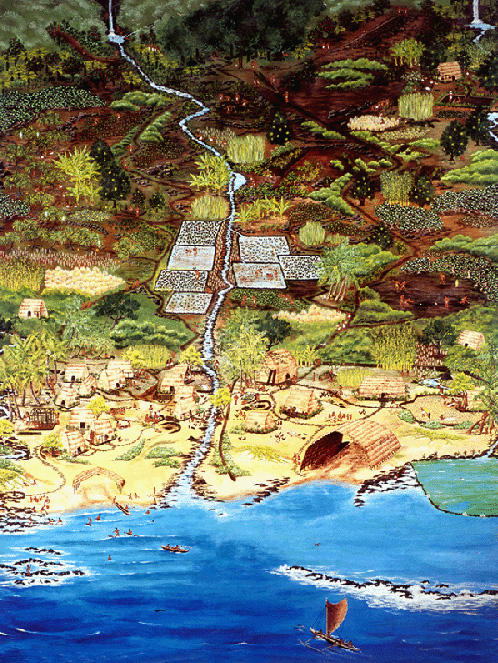
Mountain to Sea
A complete land-to-ocean system
Most ahupuaʻa extend from the top of the mountain to the shore—often following stream drainage boundaries and connecting upland forests, cultivated zones, and nearshore fisheries.
Poster: Ahupuaʻa overview (Nation of Hawai‘i archive).
Food Systems
How communities were fed
Hawaiians maintained both irrigated and rain-fed agricultural systems—cultivating kalo (taro) in irrigated areas and ʻuala (sweet potato), yams, and dryland kalo in rain-fed zones. In the māla, crops such as niu, ʻulu, maiʻa, and kō were placed where they thrive.
Water supported life across the system—drinking, bathing, gardening, fishing, and aquaculture in streams and along the shore’s edge.
Governance
How the system was managed
Ahupuaʻa were governed through layered leadership: ruled by an aliʻi (chief) and administered by a konohiki (overseer), with resource stewardship guided by cultural authorities. Seasonal restrictions and careful gathering protected fisheries, forests, and nearshore resources.
Each ahupuaʻa was divided into smaller sections called ʻili, and the ʻili were divided into kuleana—cultivated plots stewarded by the common people as part of the larger system of responsibility.
Travel was often easier up- and downstream than valley-to-valley, and each division included enough climate/resource zones to support community resilience.
Today
Modern Ahupuaʻa Restoration & Indigenous Land Management
While the historical ahupuaʻa system was systematically dismantled following the illegal overthrow of the Hawaiian Kingdom, its principles remain crucial for the future. Today, the Nation of Hawai‘i is actively reviving indigenous land management practices at the sovereign village of Puʻuhonua O Waimānalo.
By returning to traditional communal land tenure (pre-mahele), we restore ecosystem stewardship from uplands to shoreline—rebuilding food systems, water systems, and cultural responsibilities that sustain life. Modern environmental science increasingly recognizes that indigenous food systems and long-standing stewardship practices are among the most effective methods to maintain ecosystem health, safeguard biodiversity, and adapt to climate change.
Conventional “pop-up restoration” can ignore local history and impose outside goals on stolen lands. Ahupuaʻa restoration is place-based, community-led, and guided by cultural-ecological equilibrium—not extraction.
Support
Support the Ahupuaʻa Restoration Campaign
The Nation of Hawai‘i’s mission is to restore, maintain, and preserve the sophisticated religion, language, and culture of the Native Hawaiian people. To achieve this, we are determined to rebuild the self-sufficient, subsistent social system our ancestors perfected.
You can contribute to sustainable ʻāina-based nation-building by supporting ongoing restoration work, learning from our educational resources, and sharing this work with your ʻohana.
Explore resources on ahupuaʻa, stewardship, and communal land tenure.
Support hands-on ecological work and community-led restoration.
FAQ
Frequently Asked Questions
What is the Ahupuaʻa system?
An ahupuaʻa is a traditional Hawaiian subdivision of land that typically extends from the mountain to the sea, encompassing multiple climate and resource zones so a community can remain self-sufficient.
How did the Ahupuaʻa system work?
The system integrated upland forests, cultivated zones, fresh water flow, and nearshore fisheries. Communities managed resources through customary law and stewardship roles to ensure long-term balance.
Why is the Nation of Hawai‘i restoring Ahupuaʻa?
Restoration supports cultural continuity, ecological healing, food security, and sovereignty—rebuilding ʻāina-based systems at Puʻuhonua O Waimānalo and beyond.