Government and Constitution
Nation of Hawaii Fact Book

Nation of Hawaii Fact Book
We, the Kanaka Maoli — the original inhabitants and occupants of the Hawaiian Archipelago —
affirm our inherent sovereignty, our perpetual relationship to ʻāina, and our responsibility
to safeguard the wellbeing of our people, our culture, and our future generations. In pursuit
of peace, dignity, and self-determination, we reassert the right of the Hawaiian people to
restore and maintain an independent and sovereign national governance rooted in ʻike kūpuna,
mālama ʻāina, and the enduring Spirit of Aloha.
The Independent and Sovereign Nation State of Hawaiʻi derives its authority from the inherent
sovereignty of the Kanaka Maoli and the continuous presence of the Hawaiian people in these
Islands from time immemorial. This authority is further affirmed by internationally recognized
principles of self-determination and by U.S. Public Law 103-150 acknowledging the illegal
overthrow of the Hawaiian Kingdom on January 17, 1893.
The Kanaka Maoli have resided in these Islands from time immemorial. We have displaced no other
people. As the original inhabitants and occupants of the Hawaiian Archipelago, we possess inherent
and unextinguished rights to our lands, waters, and national identity.
The Independent and Sovereign Nation State of Hawaiʻi affirms the perpetual connection between the
Kanaka Maoli and the ʻāina, and asserts the right of the Hawaiian people to re-establish and maintain
their independent and sovereign governance.
Citizenship of the Independent and Sovereign Nation State of Hawaiʻi consists of:
The Nation shall establish procedures for naturalization and the recognition of citizenship for habitual
residents of Hawaiʻi, consistent with principles of equity, due process, and national integrity.
The Independent and Sovereign Nation State of Hawaiʻi affirms that the right of the Hawaiian people to
self-determination is inherent and continuing. The Nation’s governance and public institutions are organized
to protect the collective rights of the Kanaka Maoli, to uphold public order, and to advance the welfare and
future security of the Hawaiian people.
The Nation recognizes and adheres to the principles of peaceful relations, mutual respect, and good faith
engagement among peoples and nations. In its external relations, the Nation may pursue diplomacy, cooperative
agreements, and reciprocal partnerships consistent with its laws and the public interest of its citizens.
The Nation asserts that its sovereignty is not granted by any external authority, but flows from the Hawaiian
people themselves. The Nation further affirms its commitment to lawful process, responsible governance, and
the maintenance of peace in all engagements.
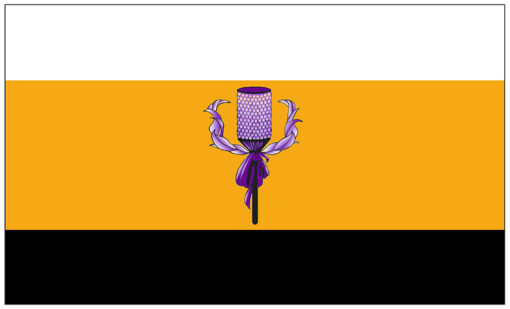
The Hawaiian Independence Flag consists of three horizontal bars: white, gold, and black (top to bottom).
The white and black each occupy one quarter of the field, and the gold occupies the central half. At the
center rests a purple kahili.
The white and black symbolize balance — Heaven and Earth, night and day, positive and negative. The gold
represents the entirety of the human ʻohana, radiant as precious life itself.
The purple signifies Nā Kanaka Maoli, original inhabitants and stewards of the Hawaiian Archipelago. The
kahili represents sacred communication between Heaven and Earth and the responsibility of leadership. It is
embraced by lāʻī (Ti leaves), a sacred plant of Hawaiʻi associated with spiritual protection and healing.
The governance of the Independent and Sovereign Nation State of Hawaiʻi is grounded in the following foundational
instruments:

Nation of Hawaii’s mission is to restore, maintain and preserve the sophisticated religion, language and culture of the Native Hawaiian people, who prior to the overthrow, lived in a highly organized, self-sufficient, subsistent social system based on Communal Land Tenure. (pre-mahele)