U.S. Public Law 100-606
November 4, 1988: 18 U.S. Code § 1091.Genocide

November 4, 1988: 18 U.S. Code § 1091.Genocide
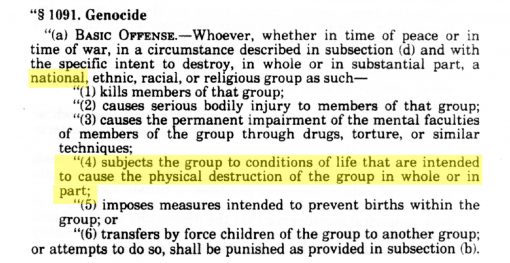
(a) Basic Offense.—Whoever, whether in time of peace or in time of war and with the specific intent to destroy, in whole or in substantial part, a national, ethnic, racial, or religious group as such—
(1) kills members of that group;
(2) causes serious bodily injury to members of that group;
(3) causes the permanent impairment of the mental faculties of members of the group through drugs, torture, or similar techniques;
(4) subjects the group to conditions of life that are intended to cause the physical destruction of the group in whole or in part;
(5) imposes measures intended to prevent births within the group; or
(6) transfers by force children of the group to another group;
shall be punished as provided in subsection (b).
(b) Punishment for Basic Offense.—The punishment for an offense under subsection (a) is—
(1) in the case of an offense under subsection (a)(1), where death results, by death or imprisonment for life and a fine of not more than $1,000,000, or both; and
(2) a fine of not more than $1,000,000 or imprisonment for not more than twenty years, or both, in any other case.
(c) Incitement Offense.—
(d) Attempt and Conspiracy.—
(e) Jurisdiction.—There is jurisdiction over the offenses described in subsections (a), (c), and (d) if—
(1) the offense is committed in whole or in part within the United States; or
(2) regardless of where the offense is committed, the alleged offender is—
(A) a national of the United States (as that term is defined in section 101 of the Immigration and Nationality Act(8 U.S.C. 1101));
(B) an alien lawfully admitted for permanent residence in the United States (as that term is defined in section 101 of the Immigration and Nationality Act (8 U.S.C. 1101));
(C) a stateless person whose habitual residence is in the United States; or
(D) present in the United States.
(f) Non applicability of Certain Limitations.—
U.S. Public Law 100-606: The Genocide Act & Hawaiian Sovereignty
Under international and domestic law, the ongoing denial of a Hawaiian national identity constitutes the international crime of genocide. The Nation of Hawai‘i firmly asserts this position through the legal framework of U.S. Public Law 100-606, commonly known as the Proxmire Act. This webpage explores the intersection of this crucial federal statute with the unextinguished sovereignty of the Native Hawaiian people.
Understanding the Proxmire Act: U.S. Public Law 100-606
Enacted by the 100th Congress on November 4, 1988, U.S. Public Law 100-606 implements the United Nations Genocide Convention into United States domestic law. Also known as the Genocide Convention Implementation Act of 1987, it amends Title 18 of the U.S. Code to establish genocide as a severe federal crime.
The statute strictly prohibits acts committed with the specific intent to destroy, in whole or in substantial part, a national, ethnic, racial, or religious group. Under 18 U.S.C. § 1091(a), the basic offenses include:
Consequently, violations involving death carry penalties of life imprisonment, and there is no statute of limitations for these indictments.
The Legal Definition of a “National Group”
A critical element of U.S. Public Law 100-606 resides in Section 1093, which provides distinct definitions for protected groups. The statute explicitly defines a “national group” as a set of individuals whose identity is distinctive in terms of nationality or national origins.
Therefore, the Kanaka Maoli clearly fit this legal definition. Prior to the arrival of Europeans in 1778, the Native Hawaiian people operated a highly organized, self-sufficient social system based on communal land tenure. Furthermore, throughout the 19th century, the United States formally recognized the independence of the Hawaiian Nation and entered into multiple treaties with its unified monarchical government. Because Native Hawaiians trace their unrelinquished identity to this internationally recognized independent state, they comprise a distinct national group under the law.
Denationalization as an Act of Genocide
The illegal overthrow of the Kingdom of Hawai‘i on January 17, 1893, resulted in the deliberate suppression of the inherent sovereignty of the Native Hawaiian people. Under international humanitarian law, the forced denationalization of an occupied territory’s inhabitants is synonymous with genocide.
During the Spanish-American War, the United States military occupied the Hawaiian Kingdom and systematically attempted to denationalize the Kanaka Maoli. By stripping the Hawaiian people of their nationality and subjecting them to conditions intended to destroy their cultural and political foundations, these actions align with the destructive acts prohibited by U.S. Public Law 100-606. The Nation of Hawai‘i recognizes this forced assimilation and denial of identity as a continuous genocidal act.
Professor Francis A. Boyle on Hawaiian Sovereignty
Dr. Francis A. Boyle, a Professor of International Law and Legal Adviser to the Nation of Hawai‘i, provides the legal foundation for these claims. During the 1993 Peoples’ International Tribunal in Hawai‘i, Boyle testified that the Kanaka Maoli have definitively been subjected to the international crime of genocide.
Boyle synthesizes U.S. Public Law 100-606 with U.S. Public Law 103-150, the 1993 Apology Resolution. The Apology Resolution serves as a formal concession by the U.S. government that the overthrow was illegal and that Native Hawaiians never relinquished their sovereignty. Consequently, Boyle concludes that Native Hawaiians possess the absolute right to restore their independent nation-state to protect themselves from further genocidal acts. He notes, “One of the few and only protections a people have from being exterminated by means of genocide, is their own state and ultimately United Nations membership”.
Rejecting Domestic “Tribal” Status
Because the Kanaka Maoli are a distinct national group, the Nation of Hawai‘i vehemently rejects any attempts by the U.S. federal government to reclassify them as a domestic “tribe”. Native Hawaiians do not share the same political and legal history as federally recognized Native American tribes.
Classifying Hawaiians merely as an ethnic or racial minority opens them up to dangerous domestic legal challenges. For instance, lawsuits relying on the Rice v. Cayetano Supreme Court decision attempt to dismantle Hawaiian trusts by framing them as racial discrimination. By actively asserting their status as a national group protected under U.S. Public Law 100-606, the Nation of Hawai‘i elevates their struggle from a domestic civil rights dispute to a matter of international law and inherent sovereignty.
Frequently Asked Questions Regarding Public Law 100-606
What is U.S. Public Law 100-606?
It is the Genocide Convention Implementation Act of 1987 (the Proxmire Act), which makes genocide a federal crime under Title 18 of the U.S. Code.
How does the Proxmire Act legally define a national group?
Section 1093 defines a national group as a set of individuals whose identity is distinctive in terms of nationality or national origins, distinct from merely racial or ethnic groups.
Why does the Nation of Hawai‘i claim the United States violated the Genocide Act?
The Nation asserts that the ongoing denial of a Hawaiian national identity and the forced denationalization of its people constitute acts intended to destroy a national group.
How does the Apology Resolution (Public Law 103-150) relate to the Proxmire Act?
The 1993 Apology Resolution officially acknowledges the illegal overthrow of the Hawaiian Kingdom. Legal experts argue this concession triggers the Kanaka Maoli’s right to restore their sovereign nation to protect against ongoing genocide.
What did the 1993 Peoples’ International Tribunal conclude?
The Tribunal heard extensive testimony and found the United States guilty of multiple charges, including acts of genocide and the illegal imposition of statehood against the Hawaiian people.

Nation of Hawaii’s mission is to restore, maintain and preserve the sophisticated religion, language and culture of the Native Hawaiian people, who prior to the overthrow, lived in a highly organized, self-sufficient, subsistent social system based on Communal Land Tenure. (pre-mahele)