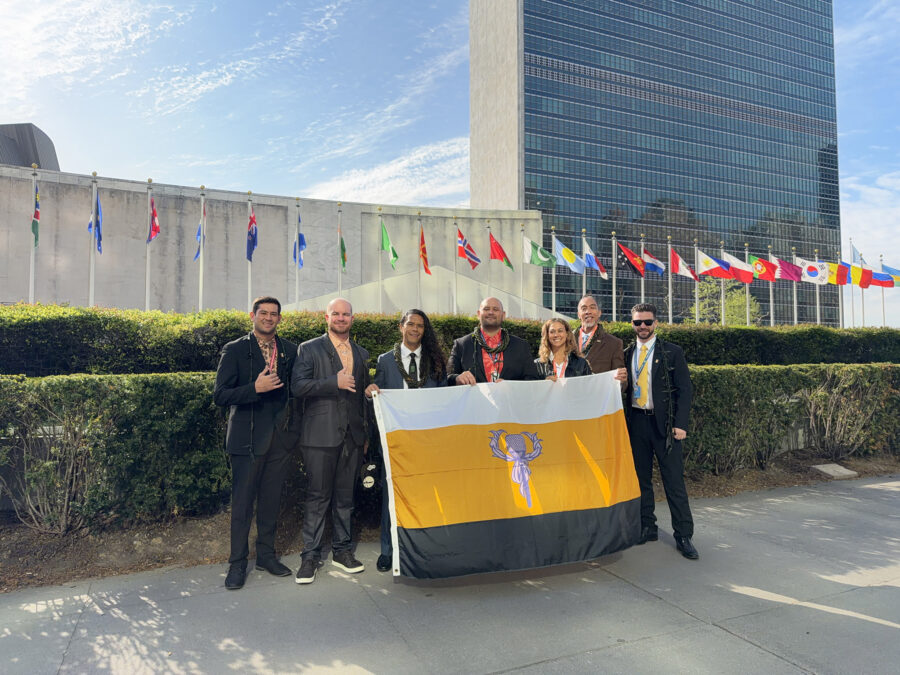
Waimānalo, HI — This past week, the Nation of Hawai‘i brought its voice to the global stage at the 25th Session of the United Nations Permanent Forum on Indigenous Issues (UNPFII), advancing a message grounded in lived experience, legal reality, and active governance.
This was not symbolic participation.
It was a coordinated effort to place Hawai‘i, clearly and directly, into the international record.
Across multiple interventions, the delegation addressed interconnected realities shaping Hawai‘i today: the devastation of Lāhainā, the diversion of water resources, the erosion of language and cultural continuity, and the ongoing impacts of displacement. Together, these narratives formed a single, unified position: What is happening in Hawai‘i is not isolated.
Lāhainā: From Local Tragedy to Global Signal
At the center of the delegation’s presence was Lāhainā, once the capital of the Hawaiian Kingdom, and now known globally for the 2023 wildfire that claimed over 100 lives and displaced more than 13,000 people.
Speaking before the Forum, representatives framed the fires not as a natural disaster, but as the result of long-standing systemic conditions tied to land use, water diversion, and decision-making structures that exclude Indigenous leadership.
The message was clear: Lāhainā is not an anomaly — it is a warning.
Water, Land, and the Conditions of Health
The delegation emphasized that Indigenous health cannot be separated from land and water.
Generations of freshwater diversion, driven by industrial agriculture, tourism, and militarization, have disrupted Hawai‘i’s natural systems, contributing to drought conditions, environmental fragility, and ultimately, increased vulnerability to disaster.
At the United Nations, this was elevated as a human rights issue, connecting Hawai‘i to a broader global pattern of Indigenous communities facing extractive systems and environmental decline.
Culture, Language, and the Right to Remain
Alongside environmental and physical impacts, the delegation addressed a less visible but equally critical dimension: cultural survival. Language, ʻike (knowledge), and identity were framed not as heritage alone, but as essential components of health.
Displacement, whether through disaster, economic pressure, or policy — disrupts the transmission of language and culture across generations. When communities are separated from land, the foundations of identity begin to erode.
The right to remain who we are is inseparable from the right to remain where we are.
Governance in Practice
While many interventions at the Forum focused on impacts, the Nation of Hawai‘i brought forward something distinct: Governance in practice.
The delegation highlighted ongoing work at Puʻuhonua O Waimānalo, where ahupua‘a-based restoration, food systems, and community stewardship continue to operate as living expressions of Indigenous governance.
Economic pathways are being rebuilt through community markets and systems of exchange grounded in reciprocity, while international relationships with other Indigenous nations continue to expand through diplomacy and treaty-building.
At the same time, Hawai‘i is stepping into a new frontier, developing Indigenous-controlled systems for governance, economy, and data, extending sovereignty into the digital environments shaping the future.
“We are not presenting theory, we are demonstrating governance in practice.”
An Unresolved Case
The Nation of Hawai‘i grounded its intervention in U.S. Public Law 103-150, which acknowledges the illegal overthrow of the Hawaiian Kingdom and affirms that Hawaiian sovereignty was never extinguished.
Yet more than three decades later, Hawai‘i remains absent from formal United Nations processes as an active case of unresolved de-occupation.
This reality framed the delegation’s central question to the international community: What pathways exist to formally engage with Indigenous governing entities where sovereignty is acknowledged, but remains unresolved?
From Presence to Pathway
The delegation’s participation opened initial lines of engagement with United Nations mechanisms, including the Special Rapporteur on the Rights of Indigenous Peoples.
Recommendations put forward included:
- Investigation into the human rights and health impacts of the Lāhainā fires and their aftermath
- Ensuring rebuilding efforts are Indigenous-led and aligned with free, prior, and informed consent
- Recognition of ongoing Native Hawaiian displacement as a human rights issue
- Consideration of a country visit or formal inquiry
What Comes Next
The work does not end at the United Nations. This moment marks the beginning of a continued effort to:
- Build direct relationships with UN bodies and Indigenous delegations
- Establish Hawai‘i within international reporting and human rights frameworks
- Advance Indigenous-led governance, restoration, and economic systems
Closing
The message carried from Hawai‘i to the United Nations was clear:
We are still here. We are still governing. And we are not waiting to be recognized to act.
0 Comments on "From Hawai‘i to the United Nations: Advancing an Unresolved Case"